
 Русский
 Português
 Español
 Français
 Deutsch
 العربية
 简体中文
简体中文 日本語
日本語 한국어
한국어

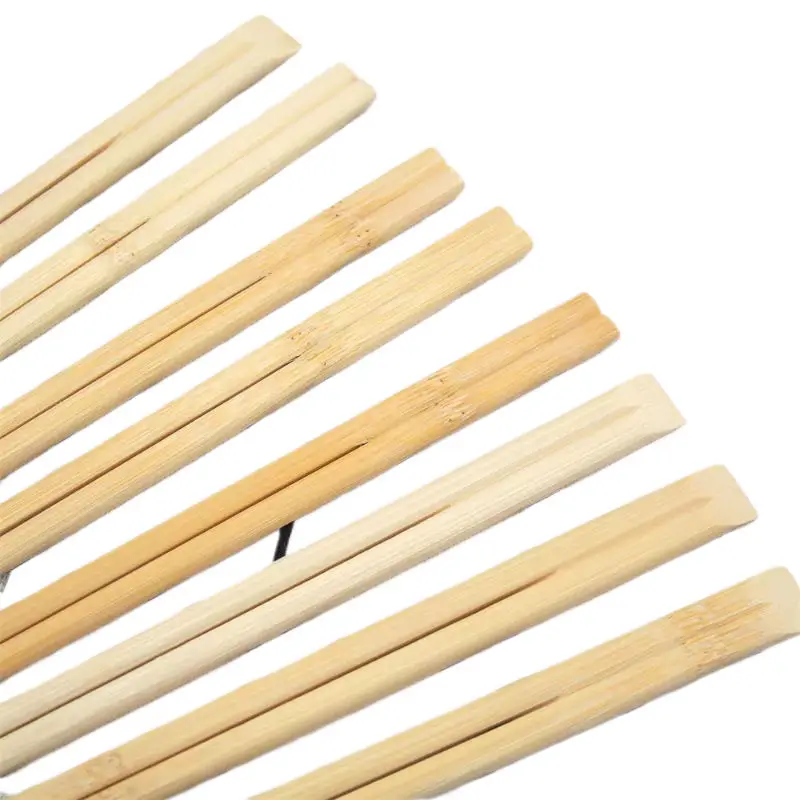
Many catering stores and group meal organizations are often troubled by frequent customer complaints when choosing Twinned Chopsticks: the chopsticks split into wood thorns when broken, break on one side, or shatter into residual sections due to uneven force, which not only affects diners’ dining experience but also lowers the brand’s service reputation. The seemingly insignificant Twinned Chopsticks rely on the Twinned Chopsticks separation force standard and production process precision for their separation feel and durability, which is also a key detail easily overlooked when purchasing high-quality tableware.
Industry Pain Point: Why Do Twinned Chopsticks Frequently Break and Splinter?
Many people default that the breakage and splintering of twinned chopsticks are caused by “improper force”, but this is not the case. For catering institutions that purchase in bulk and use on a large scale, the damage rate of twinned chopsticks is directly related to procurement costs and customer satisfaction – a test data from a chain catering shows that the damage rate of unqualified twinned chopsticks can reach more than 15%, which not only increases repeated procurement expenses but also causes customer complaints due to problems such as wood thorns pricking hands and broken chopsticks, indirectly affecting brand trust.
What is more easily ignored is that the essence of the breakage of inferior twinned chopsticks is the lack of production technology and mechanical standards: irregular V-groove cutting causes Stress Concentration, making it impossible for force to conduct evenly during separation; moisture content deviates from the standard range, leading to the loss of toughness of bamboo fibers; improper selection of raw bamboo results in messy fiber texture that cannot bear the normal separation tension. These are the core roots of frequent problems with twinned chopsticks.
Quantitative Standards: Gorlando 2026 Twinned Chopsticks Separation Mechanical Parameter Table
To solve the problem of twinned chopsticks breakage and splintering from the source, quantitative mechanical standards are the core basis. Based on the latest mass production test data in 2026 and combined with food-grade tableware production specifications, Gorlando Laboratory has established a set of precise twinned chopsticks separation mechanical testing system. All parameters have been verified by third-party authoritative institutions and can be directly used as a reference standard for bulk procurement.
| Core Test Indicators | 2026 Qualification Standards | Testing Method/Tool | Practical Use Risks | Batch Procurement Loss Reference |
|---|---|---|---|---|
| V-groove Residual Ratio | 76%-81% | High-power Industrial Microscope/Vernier Caliper (Precision 0.01mm) | High ratio is prone to Stress Concentration, leading to breakage and splintering; low ratio leads to loose chopsticks during transportation | Loss rate increases by more than 35% beyond the range |
| Standard Separation Tension | 3.6-5.8N | Digital Force Gauge (Constant Speed Tensile, Speed 5mm/min) | Excessive tension requires brute force and easy breakage; too low tension causes automatic separation during bumps | Loss rate within the qualified range can be controlled within 2% |
| Finished Product Moisture Content | 8.2%-10.1% | Pin/Inductive Wood Moisture Meter (Measurement Precision ±0.2%) | Below standard leads to brittle fiber and cracking; above standard is prone to mildew and deformation, failing to meet the Equilibrium Moisture Content (EMC) requirement | Loss rate increases by 40% when moisture content exceeds the standard |
| Bamboo Fiber Toughness Value | ≥450MPa | Universal Testing Machine (Tensile Speed 10mm/min) | Insufficient toughness leads to splintering and broken chopsticks during separation, failing to meet the requirements of Fiber Saturation Point | After-sales complaint rate increases by 50% if toughness is not up to standard |
Technical Depth: Three Core Processes Affecting Separation Quality
The separation experience and durability of a qualified food-grade twinned chopsticks depend on the refined control of three core processes – from material selection to processing and forming, deviations in each link may lead to breakage and splintering of the final product, which is also a key technical field that Gorlando has focused on for many years.
- Raw Bamboo Selection and Pretreatment Process: Gorlando selects high-quality moso bamboo aged 3-5 years, avoiding areas with dense bamboo joints (bamboo joints have dense and brittle fibers, which are prone to Stress Concentration), and cuts the middle section with uniform fibers as raw materials. In the pretreatment stage, a gradient drying process is adopted to gradually adjust the bamboo moisture content to the Equilibrium Moisture Content (EMC) range, avoiding internal stress in the fibers caused by rapid drying, improving bamboo toughness from the source, and ensuring it meets the mechanical properties corresponding to the Fiber Saturation Point.
- V-groove Cutting Process: Cutting precision directly determines the separation feel of twinned chopsticks and is also the key to avoiding Stress Concentration. Gorlando uses imported CNC cutting equipment to accurately control the cutting depth and angle of the V-groove, ensuring the notch is symmetrical and smooth, and the residual connection part is evenly stressed – in fact, the reason many manufacturers have splintering problems is that the cutting tools are not replaced in time after wear, leading to irregular notches, and force concentrates on one side during separation, directly tearing the bamboo fibers.
- Finished Product Quality Inspection and Stability Control: In mass production, Gorlando implements a “three-level quality inspection system”, randomly selecting 5% of each batch of products for mechanical performance testing, focusing on checking three core indicators: separation tension, fiber toughness and moisture content; at the same time, a constant temperature and humidity storage environment is adopted to ensure the finished product moisture content is stable in the standard range, avoiding bamboo fiber shrinkage or expansion due to changes in environmental humidity during transportation, which may cause breakage and splintering.
From the perspective of material mechanics, the separation process of twinned chopsticks is essentially a process of “uniform stress release” – high-quality craftsmanship allows stress to conduct evenly along the V-groove to achieve easy separation; while inferior craftsmanship leads to stress concentration, even a slight force will cause breakage or splintering, which is the core difference between Gorlando and ordinary manufacturers.
Procurement Guide: How to Conduct On-site “Blind Testing” and Compliance Verification
For catering institutions and tableware purchasers, mastering simple and feasible on-site “blind testing” methods can quickly screen out twinned chopsticks mass production products with qualified separation force, avoiding purchasing inferior products and increasing losses. Combined with Gorlando’s years of industry experience, here are 4 highly operable blind testing steps that can accurately judge without professional tools:
- Preliminary Appearance Inspection: Observe the V-groove of the twinned chopsticks. If the notch edge is burr-free, symmetrical and regular, the chopstick body has no cracks or moth-eaten marks, and the bamboo grain is clear and uniform, obvious process defects can be basically ruled out; if the notch is skewed and the edge is rough, there is a high probability of Stress Concentration hidden danger.
- Manual Separation Test: Place the chopsticks flat on the palm, hold both ends with both hands, and exert force evenly outward in a horizontal state. Qualified twinned chopsticks should be able to separate smoothly without jamming or splintering, and there should be no residual wood thorns on the chopstick body after separation; if brute force is required to break them, or they break with a light break, it indicates that the separation tension does not meet the standard.
- Toughness Test: After separation, gently bend the chopstick body. Qualified products should be able to bend slightly without breaking and return to their original shape after releasing, indicating that the bamboo fiber toughness is up to standard; if they break when bent, it is likely that the fiber is brittle due to too low moisture content or improper material selection.
- Compliance Verification: Request the manufacturer to provide a third-party inspection report, focusing on checking whether core indicators such as moisture content, separation tension and bamboo fiber toughness meet the latest industry standards in 2026; at the same time, verify the food contact material certification of the product to ensure that custom twinned chopsticks can also meet food-grade safety requirements.
In addition, when purchasing, priority can be given to manufacturers with their own laboratories and customized services (such as Gorlando), which can adjust the V-groove residual ratio and separation tension according to different scenarios such as takeaway, dine-in and group meals, balancing ease of use and transportation stability, and further reducing procurement losses.
Frequently Asked Questions (FAQ)
Q: For batch procurement by chain catering, how to ensure the uniform quality of twinned chopsticks in the same batch?
A: You can require the manufacturer to provide a quality inspection report for each batch, specifying the test data of core indicators such as separation tension and moisture content; at the same time, randomly select samples from different packages for blind testing. If the separation feel and toughness of all samples are consistent, it indicates that the quality stability is up to standard. Gorlando implements full-process quality inspection for each batch of products, ensuring that the parameter deviation of products in the same batch does not exceed ±0.3%, which is fully suitable for the large-scale use needs of chain catering.
Q: Can the Stress Concentration of twinned chopsticks be improved through post-processing?
A: It is difficult. Stress Concentration is mainly caused by inaccurate V-groove cutting and improper material selection, which are process defects in the production link and cannot be improved through post-processing such as polishing and drying. This is the core reason why Gorlando strictly controls cutting precision in production to avoid Stress Concentration from the source.
Q: When customizing twinned chopsticks, can the Equilibrium Moisture Content (EMC) standard be adjusted according to their own needs?
A: Yes. Gorlando can accurately adjust the finished product moisture content according to the environmental humidity of the purchaser’s location, making it suitable for the local Equilibrium Moisture Content requirements, and reducing breakage and mildew problems caused by changes in environmental humidity. For example, in humid areas in the south, the upper limit of moisture content can be appropriately increased, while in dry areas in the north, it can be slightly adjusted to the middle of the standard range to ensure product stability.
Q: What direct impact does the Fiber Saturation Point of twinned chopsticks have on separation quality?
A: The Fiber Saturation Point is a key node for bamboo fibers to maintain toughness. When the bamboo moisture content is lower than the Fiber Saturation Point, the fibers will become dry, hard and brittle, and are prone to splintering and breaking during separation; when the moisture content is higher than the Fiber Saturation Point, it will lead to mildew and deformation of the bamboo. Gorlando’s gradient drying process is to stabilize the bamboo at the moisture content range corresponding to the Fiber Saturation Point, balancing toughness and moisture resistance.
Q: How to quickly judge whether the moisture content of twinned chopsticks meets the standard during on-site blind testing?
A: It can be initially judged by hand feel – twinned chopsticks with qualified moisture content feel warm and not dry or sticky, and there is no obvious “crisp sound” when broken; if the hand feel is too dry and a crisp breaking sound is made when broken, it is likely that the moisture content is too low; if the hand feel is sticky and there is a slight musty smell, it indicates that the moisture content is too high, which does not meet the Equilibrium Moisture Content requirement.
With years of experience in tableware production, Gorlando focuses on the R&D and customization of Twinned Chopsticks. Relying on the technical advantages of its own laboratory, it integrates material mechanics principles into the entire production process, strictly controls twinned chopsticks bamboo material selection, cutting technology and separation force standards, and accurately avoids core problems such as Stress Concentration and moisture content imbalance. Whether it is bulk procurement or customized needs, Gorlando can provide products that meet the latest standards in 2026, helping catering merchants reduce procurement losses, improve dining experience, and create high-quality Twinned Chopsticks products with professional craftsmanship.
发表回复