
 Русский
 Português
 Español
 Français
 Deutsch
 العربية
 简体中文
简体中文 日本語
日本語 한국어
한국어

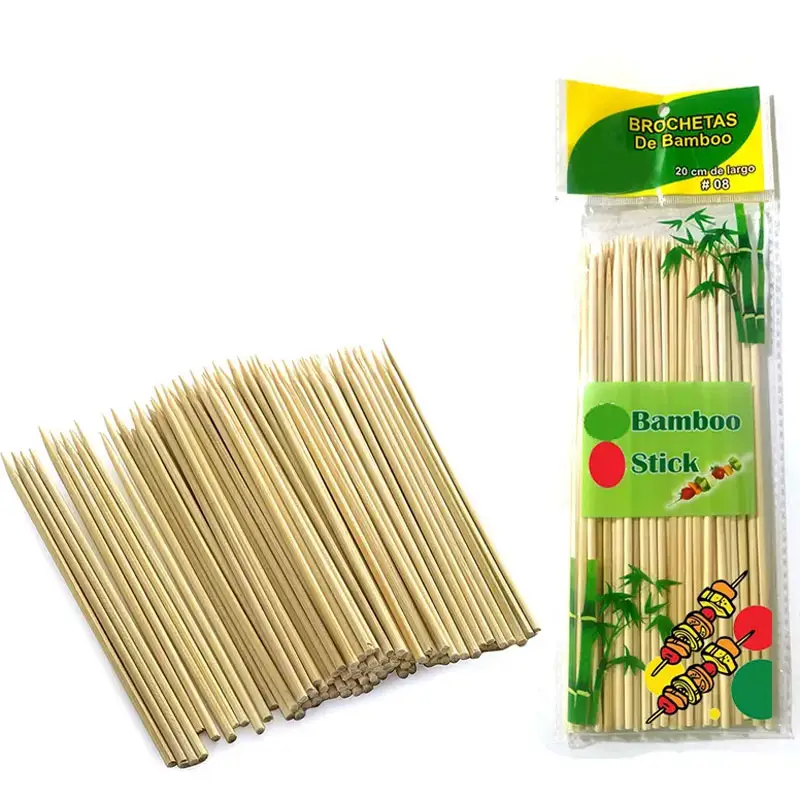
Have you ever had the frustrating experience of a Bamboo Skewer snapping the moment you place a skewer of thick meat on the grill, sending the meat tumbling into the charcoal? Or watched a skewer break while blanching beef tripe in hot pot, splashing hot soup all over the table? Even worse, some skewers have burrs that prick your fingers when threading ingredients, leaving you worried about whether they meet food safety standards—these annoying scenarios must resonate with anyone who’s ever used bamboo skewers.
In fact, people’s complaints about bamboo skewers go far beyond “fragility”: mold, burrs, poor adaptability to different scenarios, and lack of safety guarantees are the real core issues. As an enterprise with years of experience in disposable tableware production, Gorlando understands exactly what causes these pain points. A reliable bamboo skewer is never just a “make-do” tool—it should precisely solve users’ practical problems at every step. Today, we’re revealing how we make high-strength commercial bamboo skewers both durable and reassuring.
At the bamboo selection stage, we directly target the two major pain points: fragility and mold. Many bamboo skewers on the market are made from 1-2 year old young bamboo, which has loose fibers and high moisture content—they not only break easily but also tend to mold and deteriorate. We insist on using 3-5 year old natural moso bamboo. After years of growth, this bamboo has a fiber density 1.8 times that of young bamboo, naturally boasting mold and breakage resistance—this is the core strength of high-strength bamboo skewers for grilling. Our procurement team travels directly to bamboo plantations, inspecting each stalk one by one to eliminate insect-damaged, cracked, or moldy pieces, only retaining high-quality raw materials with a diameter of ≥4.5mm. Even the density of bamboo joints is strictly controlled to avoid breakage due to uneven local structure under stress.
Degreasing and drying are crucial steps to solve “brittleness and mold”. Fresh bamboo has a moisture content of over 50%; direct processing not only makes it easy to break but also encourages mold growth due to residual moisture. Gorlando adopts a three-stage low-temperature drying process, slowly dehydrating the bamboo for 72 hours to precisely control the moisture content of heat-resistant bamboo skewers for hot pot between 8%-10%: this range not only preserves the natural toughness of the bamboo, ensuring the skewers don’t become brittle even after soaking in boiling hot pot soup, but also fundamentally inhibits mold growth. In contrast, small workshops use high-temperature rapid drying to save time, which actually damages the bamboo fiber structure, making the skewers “dry on the outside but brittle on the inside”—they can break even when threading ingredients at room temperature, let alone for hot pot.
In the processing stage, we focus on solving the pain points of “burrs and poor scenario adaptability”. Many people overlook the sanding process of bamboo skewers, leading to burrs that prick fingers during use—especially when threading fruits and snacks for children, posing safety hazards. Our bamboo skewers undergo three rounds of fine sanding, with smooth edges and no sharp corners, and a surface that doesn’t catch ingredients. More importantly, we optimize the specifications for different scenarios: thin bamboo skewers for baking adopt a 2.5mm diameter, slender yet tough, without piercing cake batter or macarons; high-strength bamboo skewers for grilling have 0.3mm thickened ends, increasing load-bearing capacity by 40%, easily holding large pieces of steak and lamb chops; heat-resistant bamboo skewers for hot pot are also coated with an anti-soaking layer, remaining firm and not softening even after long-term contact with hot soup.
Every batch of finished products undergoes multiple “pain point tests”. Below is the latest 2024 test data, intuitively comparing ordinary bamboo skewers with Gorlando’s:
| Test Indicator | Regular Bamboo Skewers | Gorlando Bamboo Skewers |
|---|---|---|
| Breaking Strength | ≤3kg | ≥5kg (High-strength Commercial Bamboo Skewers standard) |
| Moisture Content | 15%-20% (prone to mold) | 8%-10% (mold-resistant threshold) |
| Surface Smoothness | Obvious burrs | Burr-free after three rounds of sanding |
| Heat Resistance (100℃) | Brittle after 30 minutes | No deformation for 2 hours (Heat-resistant Bamboo Skewers for Hot Pot standard) |
| Food-Grade Certification | None | Dual FDA & LFGB Certification (essential for food-grade safe bamboo skewers customization) |
Frequently Asked Questions
Q: Why do bamboo skewers easily mold during use—is it a storage issue or a product quality problem?
A: It’s mostly a problem with the product’s own drying process and bamboo quality. If the bamboo itself has excessive moisture content and hasn’t undergone mold-resistant treatment, it will easily mold even if stored in a sealed container. Gorlando’s bamboo skewers not only control moisture content but also incorporate physical mold-resistant technology during processing. With proper storage, the shelf life can reach 18 months, making them particularly suitable for catering scenarios with frequent use.
Q: Which specification of Bamboo Skewers should I choose for different scenarios? I’m worried that thick ones will pierce the ingredients, while thin ones will break easily.
A: That’s exactly the core advantage of our customization service. For baking, choose thin bamboo skewers for baking (2.5-3mm), slender yet tough, without damaging ingredients; for grilling, opt for high-strength bamboo skewers for grilling (4.5-5mm), with thickened ends for strong load-bearing; for hot pot, select heat-resistant bamboo skewers for hot pot (4mm), resistant to soaking and not softening; for daily use at home, such as threading fruits and snacks, a 3.5mm universal model balances toughness and ease of use. Our food-grade safe bamboo skewers customization can also adjust length and diameter according to specific needs, perfectly matching the usage scenario.
Q: Why do some thick-looking bamboo skewers still break easily at stress points?
A: The key lies in bamboo integrity and process precision. Many thick bamboo skewers are spliced, and the stress points are at the joints, making them naturally prone to breaking; others have excessive diameter tolerance, appearing thick but actually thin in local areas. Gorlando’s bamboo skewers are made from whole bamboo stalks, with diameter tolerance controlled at ±0.1mm, ensuring even stress distribution—that’s why high-strength commercial bamboo skewers can withstand repeated use.
From mold and breakage resistance during bamboo selection, to precise moisture control during drying, and scenario-specific specification optimization during processing, a qualified Bamboo Skewer goes through 12 quality control procedures. Gorlando has always believed that a good bamboo skewer shouldn’t make users compromise—it should actively solve all kinds of troubles during use. If you’re also troubled by fragile, moldy, burr-prone, or scenario-incompatible bamboo skewers, give our products that specifically address these pain points a try. After all, whether it’s a family gathering or commercial use, a durable, safe, and scenario-adaptable bamboo skewer is what makes the dining experience seamless.
发表回复