
 Русский
 Português
 Español
 Français
 Deutsch
 العربية
 简体中文
简体中文 日本語
日本語 한국어
한국어


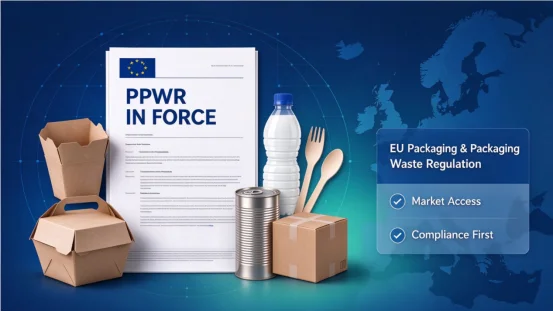
The European Union’s Packaging and Packaging Waste Regulation (PPWR) has officially entered its application phase, marking one of the most sweeping regulatory overhauls of packaging rules in the bloc’s history. Since August 12, 2026, the regulation has been directly binding across all 27 member states, replacing the 1994 Packaging and Packaging Waste Directive (PPWD) and introducing a harmonized, life-cycle approach to packaging sustainability.
Unlike its predecessor, which required national transposition and led to fragmented implementation across member states, the PPWR applies directly without the need for domestic legislation. This shift eliminates the regulatory divergence that has long frustrated businesses operating across multiple EU markets.
A Phased Regulatory Timeline
The regulation’s obligations will roll out progressively rather than taking effect all at once. Since August 2026, new substance restrictions have applied, including strict limits on per- and poly fluorocarbon substances (PFAS) in food-contact packaging. Individual non-polymeric PFAS are capped at 25 parts per billion (ppb), with a combined limit of 250 ppb for the sum of PFAS compounds.
Further milestones lie ahead: harmonized material labeling requirements are set for August 2028, while January 1, 2030 will trigger the most consequential wave of obligations. From that date, all packaging must be designed for recycling and meet minimum recycled content thresholds—including a 30% recycled content requirement for single-use plastic beverage bottles, rising to 65% by 2040. Certain single-use plastic formats, including packaging for fresh fruit and vegetables under 1.5 kilograms, will face outright bans starting in 2030.
By 2035, packaging must be recyclable at industrial scale, and by 2040, higher reuse and recycled content targets will apply.
What It Means for E-Commerce and Logistics
The PPWR introduces specific provisions targeting the rapidly growing e-commerce sector. Article 24(1) requires that e-commerce packaging be designed to reduce empty space, with a maximum void space ratio of 40% for transport packaging from August 2026 and a broader 50% threshold for e-commerce, grouped, and transport packaging from 2030. Fillers and padding count as empty space—a provision designed to prevent businesses from circumventing the rule through excessive cushioning materials.
Reuse targets add another layer of complexity. By 2030, at least 40% of transport and sales packaging must be reusable, with a 10% target for grouped packaging.
However, the European Commission has shown willingness to adjust rules where compliance proves impractical. In February 2026, the Commission adopted a delegated act exempting pallet wrapping film and plastic strapping from the original 100% reuse requirement, following industry feedback that full reuse in internal transport operations would impose disproportionate costs and logistical challenges.
Industry Reactions: Support Mixed with Concern
The regulation has drawn a mixed response. Smaller businesses have expressed particular concern about administrative burdens. SME united, a European association representing small and medium-sized enterprises, has argued that the PPWR’s implementation is “creating confusion, legal uncertainty, and disproportionate burden for small businesses”.
In Germany, the Federation of German Food and Drink Industries (BVE) has called for amendments to the PPWR producer register, advocating for a binding European core data set for packaging to reduce duplicate reporting across member states. The BVE argues that quantities and material compositions are already collected by extended producer responsibility organizations, and that requiring the same data in the producer register increases administrative overhead without environmental benefit.
Meanwhile, countries are beginning to exercise the flexibility the PPWR affords. Italy became the first member state to invoke the regulation’s compo-stability option, issuing a legislative decree in August 2026 that mandates compos-table alternatives for certain single-use plastic packaging formats, including fresh produce packs and condiment portions.
On the other side of the debate, Flexible Packaging Europe has warned against any delay or renegotiation of the regulation, arguing that reopening the text would undermine legal certainty for businesses already investing in compliance.
Non-Compliance Risks and Enforcement
The stakes for non-compliance are substantial. Penalties are determined at the member state level but can include fines of up to €200,000 and bans on placing products on the market. Producers placing packaging on the EU market—including manufacturers, importers, distributors, and e-commerce operators—are subject to extended producer responsibility obligations and must prepare a Declaration of Conformity for each packaging type.
Micro-enterprises with fewer than 10 employees and annual turnover not exceeding €2 million benefit from lighter rules in certain areas, but still remain subject to core sustainability requirements.
Looking Ahead
The PPWR represents a fundamental shift in how packaging is regulated across Europe. It moves beyond waste management targets to mandate changes at the design stage—dictating what packaging must look like before it ever reaches the market. For businesses across the packaging value chain, the message is clear: the era of treating packaging as an afterthought is over. Those who adapt early stand to gain a competitive edge in the E U’s evolving circular economy, while those who lag risk losing access to the world’s second-largest consumer market.
发表回复