
 Русский
 Português
 Español
 Français
 Deutsch
 العربية
 简体中文
简体中文 日本語
日本語 한국어
한국어
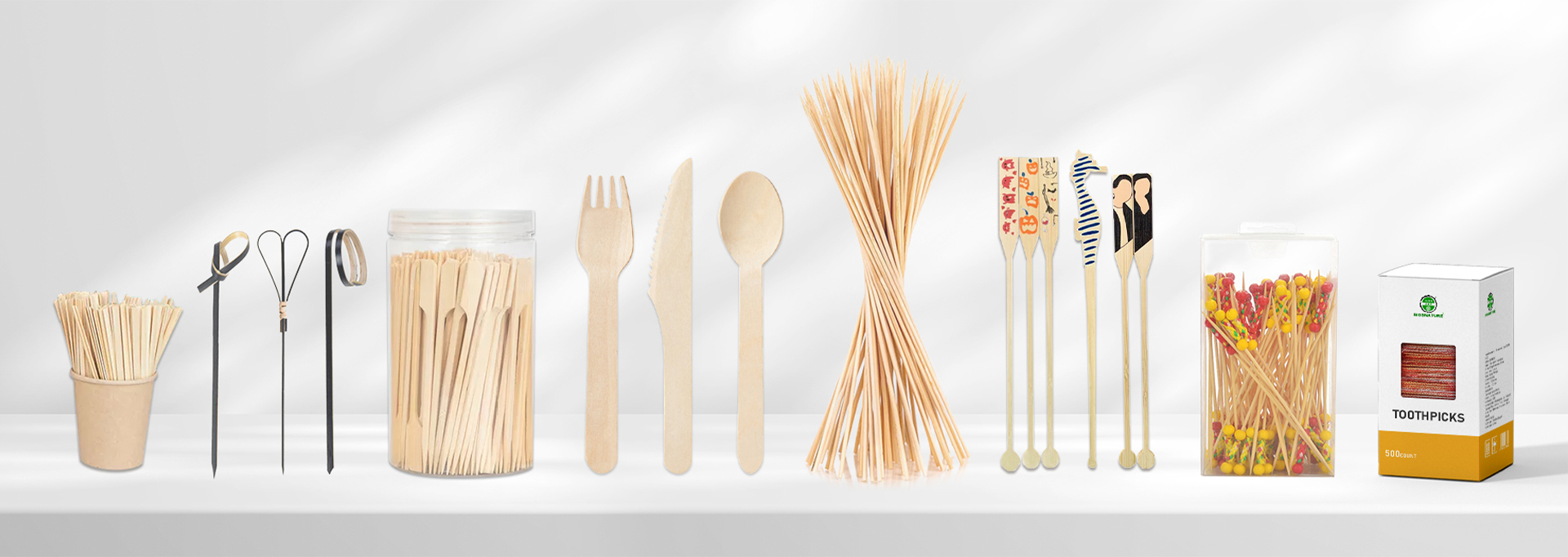
By the Gorlando Export Team — Guangzhou Gorlando Commodity Co., Ltd., a bamboo and eco-friendly disposable tableware manufacturer operating since 2010 (15+ years), exporting to 28 countries from a 20,000 m² production base with three branch plants.
Direct answer: Sourcing bamboo cutlery wholesale in 2026 means qualifying a factory on four things, not just unit price: food-contact certifications (FDA for the US, LFGB for the EU/UK, FSC for sustainable sourcing), measurable quality controls (smooth splinter-free finish, water absorption ≤8% after 24h, thermal stability to 70°C), realistic MOQs and lead times, and a documented OEM/private-label process. A certified, 15+ year factory with in-house QC protects you from customs holds, recalls, and batch defects far better than the cheapest quote.
Why “wholesale bamboo cutlery” is a specification problem, not a price problem
Most import failures we see are not caused by the fork being a cent too expensive — they are caused by a missing certificate at the border, splinters in a food-service batch, or a supplier that cannot repeat the first sample. When you buy disposable bamboo cutlery by the container, you are really buying consistency and compliance, and those come from process, not from a low FOB number.
This guide compresses what our export team checks on every new wholesale program so you can build the same shortlist before you request a quote.
What material should bamboo cutlery be made from?
Specify Moso bamboo (Phyllostachys edulis) wherever possible. Moso is denser and harder than lesser species, which is why it splinters less and holds its shape under hot food. Ask the supplier directly which species they use — a vague “natural bamboo” answer is a red flag.
At Gorlando we process Moso sourced through FSC-tracked supply, then kiln-dry and polish each piece. The result is a smooth, splinter-free utensil that reads as premium in a restaurant or retail kit, not a rough picnic stick.
Which certifications actually matter for wholesale bamboo cutlery?
Do not treat certifications as paperwork. Each one unlocks a specific market and a specific buyer:
| Certificate | What it proves | Required for |
|---|---|---|
| FDA 21 CFR (US food-contact) | Safe for food contact in the US/Canada | USA, Canada |
| LFGB | EU/UK food-contact gold standard; requires an actual test report | EU, UK |
| FSC | Responsibly sourced bamboo | EU retail, ESG-driven buyers |
| EN 13432 / ASTM D6400 | Industrially compostable claim is verifiable | Eco-labeled programs |
| ISO 22000 / BRC | Manufacturing hygiene management | Premium retail, food chains |
A claim alone is not certification. For LFGB and FDA, request the test report PDF and a compliance letter, not a logo on a website. For EU-bound orders in 2026, also confirm EUDR (deforestation-regulation) traceability — this is now a mandatory entry requirement, not a nice-to-have.
What quality tests should you require before a bulk order?
These are the objective checks we run on every production lot. Put them in your purchase order so the factory is contractually accountable:
- Water absorption ≤ 8% after 24-hour immersion — high absorption means the utensil softens and warps in sauces or soups.
- Smooth finish, zero splinters under 10x magnification — the single biggest cause of customer complaints in food service.
- Drop resistance ≥ 10 drops without cracking or splintering.
- Thermal stability to 70°C (158°F) — required if the cutlery touches hot or acidic food.
- Migration testing for food-contact safety (heavy metals / chemicals do not leach).
If a supplier cannot show you a recent third-party lab report for these, you are betting your brand on an unverified batch.
What are realistic MOQs and lead times in 2026?
Market-wide, standard off-the-shelf bamboo cutlery usually carries a minimum order of 10,000–50,000 units. Private-label and custom-tooling programs sit higher. Typical factory-direct FOB ranges reported across 2026 sourcing platforms run roughly $0.008–$0.015 per 160 mm bamboo fork at 100k+ units, with kraft cutlery kits (fork + knife + spoon) in the $0.03–$0.06 band — but your landed cost also includes freight, duties, and any retesting, so always evaluate total cost of ownership, not just the unit price.
Lead times to plan around:
- Repeat orders: 20–30 days from confirmation.
- New tooling / first OEM run: 30–40 days, plus sampling time.
A supplier quoting 10-day “express” bulk production is almost certainly cutting a corner you will pay for later.
How does the OEM / private-label process work?
A proper OEM program should be predictable, not a mystery. Our standard flow for wholesale buyers:
- Brief & sampling — you share specs (length, finish, pack format) or pick from our catalog; we ship free samples for sign-off.
- Customization — logo laser-engraving, custom kraft sleeve, private-label retail box, and barcode assignment.
- Pre-production confirmation — approved sample becomes the bench standard for the whole run.
- Mass production + in-line QC — checks at drying, polishing, and packing stages.
- Final inspection & docs — photos, QC report, and certificates bundled before container load.
- Shipping — FOB, CIF, or DDP depending on your experience level.
Keep tooling fees and reorder MOQs in writing. A serious factory states them up front instead of surprising you at deposit time.
Which product lines should a wholesale program cover?
A complete disposable bamboo cutlery range lets one relationship cover your full eco-tableware plan:
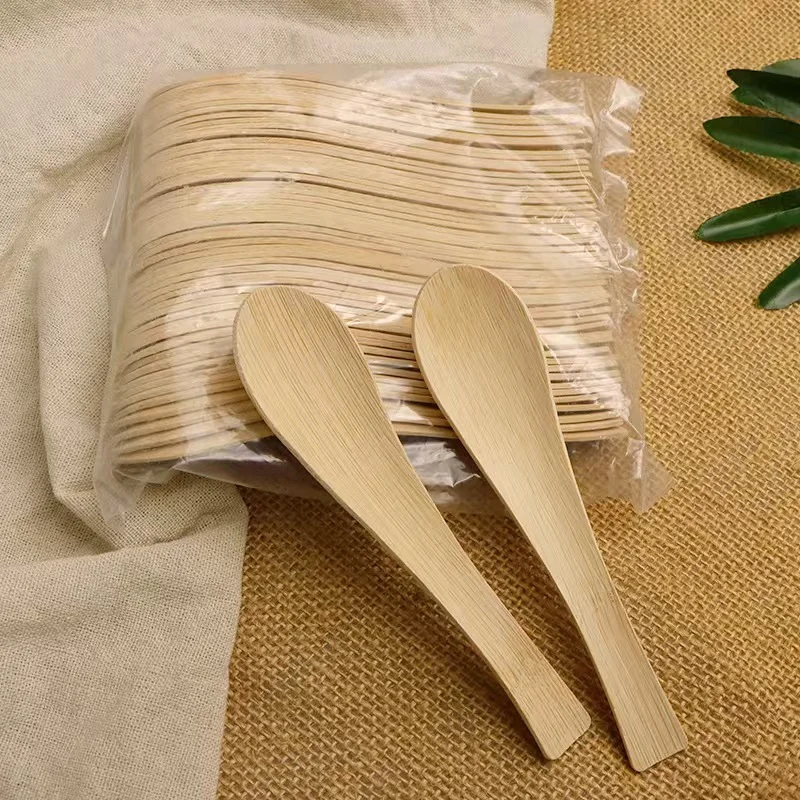
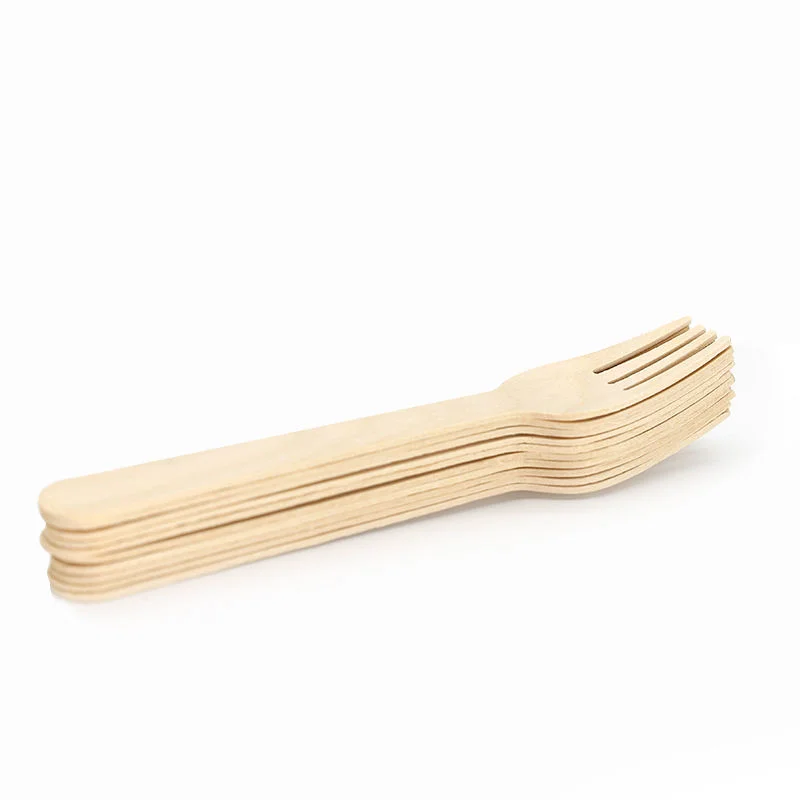
- Individual pieces: fork (160 mm), knife (160 mm), spoon (155 mm), spork.
- KFS kits: fork + knife + spoon in a kraft sleeve — the default for takeout and catering.
- Complementary lines: bamboo skewers, toothpicks, and stirrers that share the same certifications and QC.
If you want to see how a full bamboo product line is built and QC’d, review our bamboo skewers for food service as a reference category.
Frequently asked questions
Is bamboo cutlery actually compostable? Only with the right certification. Look for EN 13432 (EU) or ASTM D6400 (US) on the test report. “Biodegradable” without a standard is a marketing claim, not a verified one.
Can I get my logo on small orders? Many factories now engrave or sleeve from low MOQs, but per-unit cost rises at small volume. Plan a 20,000+ unit run if you want branded pricing to make sense.
How do I avoid splinters in a bulk order? Require the smooth-finish / 10x magnification check in your PO and request the QC photos from a pre-shipment inspection. This single clause removes most food-service complaints.
What kills a shipment at customs? A missing or unverifiable LFGB/FDA document, or (for the EU in 2026) no EUDR traceability. Certificates are cheaper than a detained container.
Why buyer due diligence protects your brand
Wholesale bamboo cutlery is a commodity only on the surface. Underneath, the difference between a reliable program and a recall is process: named species, verifiable certificates, measurable QC, and a factory that has done it for 15+ years across 28 export markets. Qualify on those, and the unit price takes care of itself.
To see how real food-service and catering buyers deploy our tableware, browse our application cases. To verify our facility, certifications, and export record, visit our company profile.
发表回复